TASK-
Zero an M16A2 Rifle
CONDITIONS- On a 25-meter range, given an M16A2
rifle, 18 rounds of 5.56-mm ammunition, a
300-meter zero target, and sandbags for
support.
STANDARDS–
Using 18 rounds or less, the soldier must
battlesight zero his rifle by achieving
five out of six rounds in two consecutive
shot groups within the 4-centimeter
circle. Bullets that break the line
of the 4-centimeter circle will be used in
evaluating the soldier’s performance.
TRAINING AND
EVALUATION–
1.
The M16A2 rifle has two adjustable sights
— front and rear. Elevation
adjustments are made using the front
sight, and elevation changes and windage
adjustments are made using the rear sight.
2.
The sight systems.
a. The rear sight has an elevation
knob with range indicators from 300 to 800
meters and two apertures for range.
One aperture is marked 0-2 for short range
from 0-200 meters and an unmarked aperture
for normal range from 300 to 800 meters.
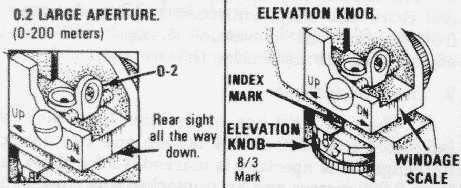
(1) The 0-2 (large) aperture is used
for short range (Figure 107). This
aperture is used only when the rear sight
is all the way down. The 8/3
(300-meter) mark on the elevation knob is
aligned with the index mark on the left
side of the receiver.
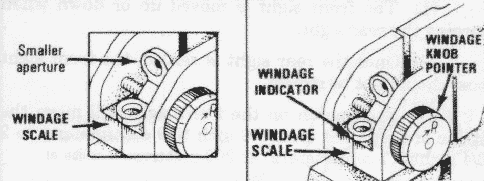
(2) The unmarked (small) aperture
(Figure 108) is used for normal range.
This aperture is used for most firing
situations. It is used in
conjunction with the elevation knob for
300- to 800-meter targets.
b. The rear sight also consists of a
windage knob on the rear side of the sight
(Figure 109).
(1) Each click of the windage knob
will move the strike on the round from 1/8
inch (.3 centimeters) at 25 meters to 4
inches (10 centimeters) at 800 meters.
(2) A windage scale is on the rear
of the sight and the windage knob pointer
is on the windage knob.
c. The front sight consists of a rotating
sight post with a spring-loaded detent
(Figure 110).
.
Rear sight
(Left) Unmarked
aperture
(Right) Windage knob.
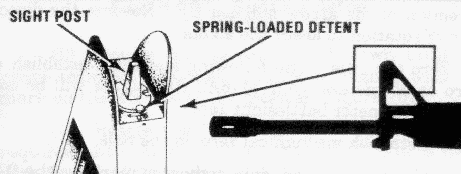
Front sight
-
The
front sight is moved up or down when
zeroing the rear sight
-
Once
the rear sight is zeroed, the front
sight post should not be moved
-
Each
notch on the front sight will move the
strike of the bullet from 3/8 inch
(0.9 centimeters) to 2 3/4 inches (7
centimeters) at 200 meters.
3.
Sight
adjustments.
a. Rear sight.
(1) To adjust windage or move the
strike of the round, turn the windage knob
counterclockwise to move the strike to the
left and clockwise to move the strike to
the right (Figure 109).
(2) To adjust elevation, turn the
elevation knob until the desire range is
indexed at the index mark on the left side
on the sight (Figure 107).
b. Front sight. To adjust
elevation, depress the detent and rotate the
sight post (Figure 111). To raise the
strike of the round, rotate the sight post
in the direction of the arrow marked UP.
Reverse the direction of rotation to lower
the strike.
4.
Zero the rifle. The following steps will establish a zero at 25 meters,
your M16A2 rifle sights will be set with a 300-meter battlesight zero.
a. Establish mechanical zero on the
rifle.
(1) Align the windage indicator mark
on the 0-2 aperture with the center line
of the windage scale (the unmarked
aperture is up) (Figure 109).
.
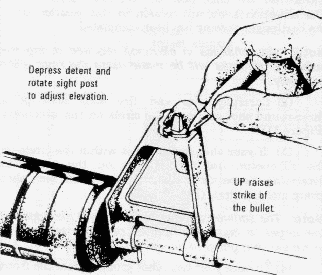
Figure 111.
Depress detent..
(2)
Rotate the elevation knob down until the
range scale 8/3 (300-meter) mark is
aligned with the mark on the left side of
the receiver (Figure 107).
(3) Rotate the
front sight post up or down as require
until the base of the front sight post is
flush with the top of the sight post well.
b. Zero at 25 meters.
(1) After setting the front and rear
sights to mechanical zero, the elevation
knob is rotated up (clockwise) one click
past the 8/3 (300-meter) mark. The elevation
knob will remain in this position until the
battlesight zeroing has been completed.
NOTE:
Any
changes in elevation required during the zeroing procedures will be made using
the front sight post only.
(2) Carefully aim and fire each shot
of a three-shot group at the circle on the
silhouette (Figure 112).
(3)
If your shot group is not within the circle
on the silhouette, use the squares on the
target to determine the required clicks to
move your next shot group into the circle
(Figure 112).
NOTE:
The
squares are numbered around the edges of the target to equal the number of
clicks required to move the shot group to the circle.
(4) To raise your next shot group,
rotate the front sight post UP (clockwise).
To lower your next shot group, rotate the
front sight post DOWN (counterclockwise).
One click will move the strike of the round
one square on the target.
(5)
To move the shot group to the left, turn the
windage knob counterclockwise. To move
the shot group to the right, turn the
windage knob clockwise. Three clicks
of the windage knob will move the strike of
the round one square on the target.
(6)
Continue to fire three-round shot groups and
make corrections until you have a tight shot
group in the circle on the silhouette.
.
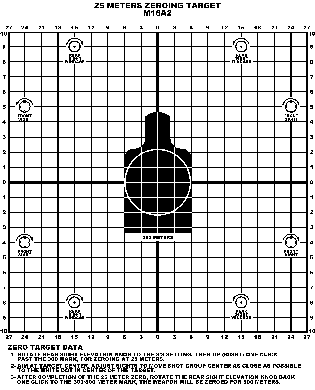
25-meter zero
target.
(7)
If your shot group is within the circle,
your rifle is now "calibrated."
(8)
To place your 300-meter zero on the rifle,
you must rotate the elevation knob one click
counterclockwise. The 8/3 (300-meter) mark
on the elevation knob should now be aligned
with the index mark on the left side of the
sight.
NOTES:
1. There are clicks between the
range numbers as you turn the elevation
knob. Use these clicks if you need
more elevation past a certain range number
to hit a target.
2. The unmarked aperture is
automatically zeroed to 200 meters.
Use the 0-2 aperture when shooting at night
or at close ranges; for example, in an urban
environment or in dense jungle.
5. Sight setting.
your rifle sights should be kept set to a combat zero of 300 meters. If
you are told to engage a target at a longer range; for example, 500 meters:
a. Rotate the elevation knob so that
the desired range mark is aligned with the
index mark on the left side of the sight.
b.
Engage the target.
c. When
the engagement is over, return the sight
to the 300-meter setting.
NOTE:
When the rifle has been zeroed to 300
meters, all other ranges on the elevation
knob are also zeroed.
|

