Character Development
Everyone who becomes part of America’s Army, soldier or DA civilian, has character. On the day a person joins the Army, leaders begin building on that character. Army values emphasize the relationship between character and competence. Although competence is a fundamental attribute of Army leaders, character is even more critical. This appendix discusses the actions Army leaders take to develop their subordinates’ character.
Army leaders are responsible for refining the character of soldiers and DA civilians. How does the Army as an institution ensure proper character development? What should leaders do to inculcate Army values in their subordinates?
Leaders teach Army values to every new member of the Army. Together with the leader attributes described in Chapter 2, Army values establish the foundation of leaders of character. Once members learn these values, their leaders ensure adherence. Adhering to the principles Army values embody is essential, for the Army cannot tolerate unethical behavior. Unethical behavior destroys morale and cohesion; it undermines the trust and confidence essential to teamwork and mission accomplishment.
Ethical conduct must reflect beliefs and convictions, not just fear of punishment. Over time, soldiers and DA civilians adhere to Army values because they want to live ethically and profess the values because they know it’s right to do so. Once people believe and demonstrate Army values, they are persons of character. Ultimately, Army leaders are charged with the with the essential role of developing character in others. Figure E-1 shows the leader actions that support character development.
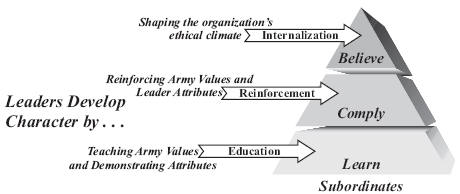
Character Development Pyramid
LEADERS TEACH VALUES; SUBORDINATES LEARN THE CULTURE
Army leaders must teach their subordinates moral principles, ethical theory, Army values, and leadership attributes. Through their leaders’ programs, soldiers and DA civilians develop character through education, experience, and reflection. By educating their subordinates and setting the example, Army leaders enable their subordinates to make ethical decisions that in turn contribute to excellence. Subordinates gain deeper understanding from experiencing, observing, and reflecting on the aspects of Army leadership under the guidance of their leaders.
Inculcating Army values doesn’t end with basic training. All Army leaders should seek to deepen subordinates’ understanding of the ethical aspects of character through classes, informal discussions, one-on-one coaching, and formal developmental counseling. Army leaders can also improve their own understanding through study, reflection, and discussions with peers and superiors.
LEADERS REINFORCE VALUES; SUBORDINATES COMPLY
Leaders reinforce and discipline behavior to guide subordinates’ development. To help subordinates live according to Army values, leaders enforce rules, policies, and regulations. Still, soldiers and DA civilians of character do more than merely comply with established institutional rules. Acting correctly but without complete understanding or sound motivation is not good enough in America’s values-based Army. People of character behave correctly through correct understanding and personal desire. Understanding comes from training and self-development. Personal desire comes from a person’s realization that Army values are worth adopting and living by and from that person’s decision to do just that.
Character stems from a thorough understanding of Army values; however, this understanding must go beyond knowing the one-line definitions. Individuals must also know why Army values are important and how to apply them to everyday Army life. Leaders can promote Army values by setting the example themselves and pointing out other examples of Army values in both normal and exceptional activities. Army leaders can use unit histories and traditions, prominent individuals, and recent events to bring Army values to life and explain why adhering to them is important.
LEADERS SHAPE THE ETHICAL CLIMATE; SUBORDINATES INTERNALIZE ARMY VALUES
Doing the right thing is good. Doing the right thing for the right reason and with the right intention is better. People of character must possess the desire to act ethically in all situations. One of the Army leader’s primary responsibilities is to maintain an ethical climate that supports development of such a character. When an organization’s ethical climate nurtures ethical behavior, over time, people think, feel, and act ethically-they internalize the aspects of sound character.
Leaders should influence others’ character development and foster correct actions through role modeling, teaching, and coaching. Army leaders seek to build a climate in which subordinates and organizations can reach their full potential. Together, these actions promote organizational excellence.
Army leaders can use the ECAS to assess ethical aspects of their own character and actions, the workplace, and the external environment. Once they have done their assessment, leaders prepare and carry out a plan of action. The plan of action focuses on solving ethical problems within the leaders’ span of influence; leaders pass ethical problems they cannot change to higher headquarters. E-12. Becoming a person of character and a leader of character is a career-long process involving both selfdevelopment and developmental counseling. While individuals are responsible for their own character development, leaders are responsible for encouraging, supporting, and assessing the efforts of their subordinates. Leaders of character can develop only through continual study, reflection, experience, and feedback.

