|
Performance Steps
|
|
1. Assume a suitable firing position. Based on your
situation, select a firing position
that will allow you to observe and
engage targets yet minimize your
exposure to enemy fire.
|
a.
Seated firing positions.
Sit directly behind the weapon between
the trail legs of the tripod.
|
(1)
Legs extended. Extend your
legs under the tripod (figure 071-030-0004-1).
|
|
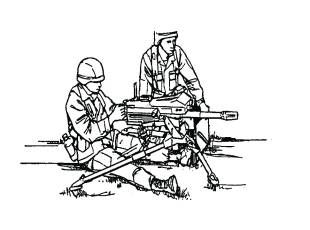
Figure 071-030-0004-1.
Seated firing position, legs extended
|
(2)
Legs crossed. Cross your
legs and place your elbows on the
inside of your thighs for support when
firing the weapon (figure 071-030-0004-2).
|
|
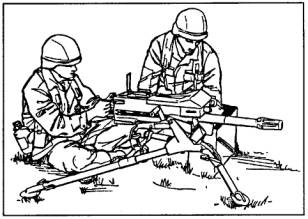
Figure 071-030-0004-2.
Seated firing position, legs crossed
|
(3)
Legs braced. Extend your
legs, brace them on the trail legs of
the tripod, and place your elbows on
the inside of your thighs for support
(figure 071-030-0004-3).
|
|
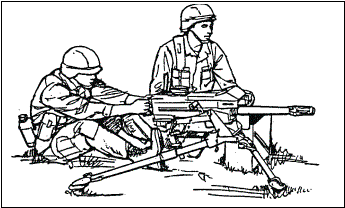
Figure 071-030-0004-3.
Seated firing position, legs braced
|
b.
Kneeling position. Kneel
and grasp the control grips with your
thumbs on the trigger (figure 071-030-0004-4).
|
|
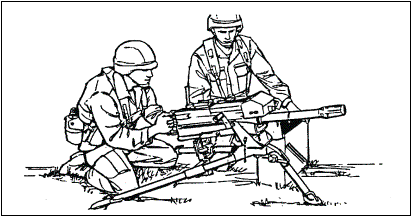
Figure 071-030-0004-4.
Kneeling position
|
c.
Standing position for gun
mounted on a vehicle pedestal (figure 071-030-0004-5).
|
|
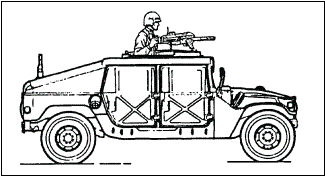
Figure 071-030-0004-5.
Standing position for mounted gun
|
|
2. Acquire the target using correct sight alignment.
|
|
3. Apply correct engagement technique based on target
types.
|
a.
Use correct gun
manipulation technique (figure 071-030-0004-6).
|
(1)
Fixed fire. This is fire
delivered against a point target. Only
one aiming point is necessary with
little or no manipulation of the gun.
|
(2)
Traversing fire. This is
fire distributed against a wide target
requiring successive changes in
direction of gun. This means using the
T&E mechanism to traverse the gun
left or right to distribute fire
laterally.
|
(3)
Searching fire. This is
fire delivered against a deep target
or a linear target with depth in width
by successive changes in elevation.
This means using the T&E mechanism
to move the muzzle of the weapon up or
down to distribute fire in depth.
|
(4)
Traversing and searching
fire. This is fire delivered in width
and depth by successive changes in
direction and elevation. It is
employed against a target whose long
axis is oblique to the direction of
fire.
|
(5)
Swinging traverse. This is
fire delivered against targets that
require major changes in direction but
little or no change in elevation.
Loosen the traversing slide lock
enough to swing the gun laterally.
|
(6)
Free gun. This is fire
delivered against moving targets that
must be rapidly engaged with fast
changes in direction and elevation. To
fire free gun, remove the T&E
mechanism.
|
|
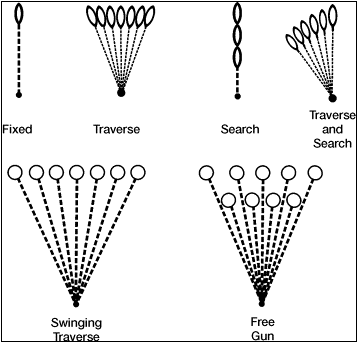
Figure 071-030-0004-6.
Techniques of fire with respect to the
MK19
|
b.
Use correct application of
fire to engage specific targets.
|
(1)
Point target. Engage point
targets with fixed fire using a single
aiming point (figure 071-030-0004-7).
|
|
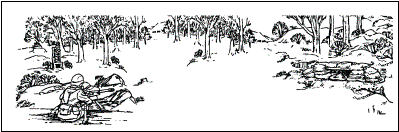
Figure 071-030-0004-7.
Point target
|
(2)
Linear target. Initially
aim just outside either flank and
fire. Traverse fire back and forth
from flank to flank, covering the
entire target area (figure 071-030-0004-8).
|
|
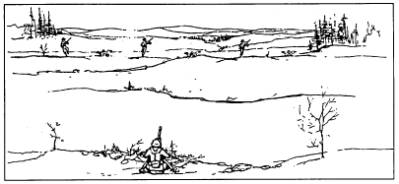
Figure 071-030-0004-8.
Linear target
|
(3)
Linear target with depth.
Initially aim at the near flank with
range set to the midpoint of the
target unless another portion of the
target is more critical or presents a
greater threat. Fire on the near
flank, then traverse and search back
and forth, covering the entire target
(figure 071-030-0004-9).
|
|
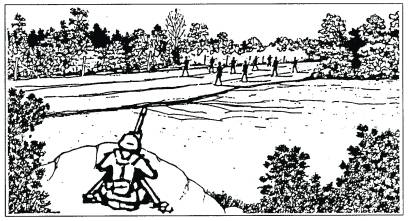
Figure 071-030-0004-9.
Linear target with depth
|
(4)
Deep target. Initially aim
at the end of the target closest to
the gun, unless another portion of the
target is more critical or presents a
greater threat (auto rifleman). Fire
and search up the far end and back
again repeatedly (figure 071-030-0004-10).
|
|
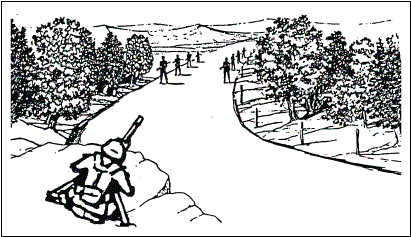
Figure 071-030-0004-10.
Deep target
|
(5)
Area target. Initially aim
at the midpoint of the target area.
Traverse and search to either flank,
then traverse and search to the
opposite flank (figure 071-030-0004-11).
|
|
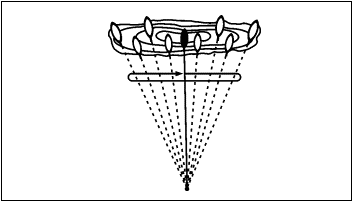
Figure 071-030-0004-11.
Engagement of area targets, single gun
|
|
4. Use observation of fire and adjusted aiming point
to place effective fire on the target.
|
a.
Observation of fire.
Observe the strike of the rounds in
relation to the target; adjust
elevation and direction needed to move
the center of impact onto the target.
|
|
Note. This does not call for use of the sights.
Example. Suppose you fire at a target 500 meters away. The
rounds impact 20 meters short and 50
meters right. To manipulate the gun
onto the target, use the traversing
and elevating mechanism hand wheels to
move the muzzle left and up the proper
number of clicks.
|
b.
Adjusted aiming point. Use
this method to adjust fires quickly
without making a sight or T&E
adjustment (figure 071-030-0004-12).
|
(1)
If the initial burst misses
the target, rapidly select a new
aiming point the same distance from
the center of impact of the initial
burst but in the opposite direction.
|
(2)
Lay the gun on that aiming
point and fire.
|
|
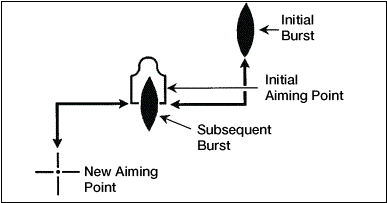
Figure 071-030-0004-12.
Adjusted aiming point method
|
|
5. Fire on the targets until they are destroyed or
until you receive an order to cease
fire.
|

