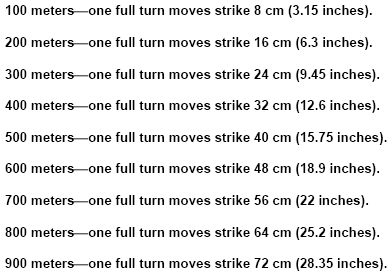
How to set the sights on the M240B Machine Gun for elevation and windage
This paragraph provides information on how to make corrections if the initial setting is not accurate. At a 10-meter target, each paster is 1 cm. Therefore, ten clicks on the adjusting screw (windage) of the front sight assembly in either direction moves the strike of the round left or right 1 cm. One complete turn on the front sight blade moves the strike of the round up or down 1 cm.
Elevation Correction. If the shot group is above or below the point of aim, the front sight posts must be adjusted using the front sight-adjusting tool. Unlock the front-sight retaining strap and rotate it up. If the shot group is above the point of aim, rotate the sight post counterclockwise. If the shot group is below the point of aim, rotate the sight post clockwise. Rotating the front sight post counterclockwise brings the point of impact down on the target. Rotating the front sight post clockwise brings the point of impact up on the target. At a range of 10 meters, one-half turn of the front sight post blade will move the point of impact by 5 mm or .5 cm. One full turn of the front sight post blade moves the point of impact by 1 cm. After rotating the front sight post blade the desired amount, lower the retaining strap, but do not lock it down until elevation is confirmed. If the front sight post blade must be rotated counterclockwise to a point where its base is past flush (Number 2 blade), it should be replaced with a Number 1 front sight blade, which is smaller than a Number 2 blade. If the front sight post blade must be rotated counterclockwise to a point where its base is more than one full turn past flush (Number 1 blade), it should be replaced with a Number 2 front sight blade which is taller than a Number 1 blade.
Windage Correction. If the shot group is to the left of the point aim, move the front sight assembly to the right to shift the point of impact to the left (towards the point of aim). Using the front sight adjusting tool, loosen (turn counterclockwise) the adjusting screw on the front sight assembly the desired amount. Then tighten (turn clockwise) the opposite side screw on the left exactly the same number of clicks. At a range of 10 meters, one complete rotation of the adjusting screws will move the point of impact 8 mm or .8 cm. As the adjusting screws are turned, noticeable clicks (eight per revolution) should be detected. Each click is 1 mm or .1 cm. If this is not the case, have your armorer repair it. The front sight windage adjusting procedure is the combination of creating slack on one side, and then taking up that slack from the opposite side. The front sight protector assembly should always be clamped between the heads of the two opposing screws. Remember, each time one screw is loosened or backed off, the opposite screw must be turned exactly the same amount. Check for play in the front sight assembly by lightly clamping it between finger and thumb and attempting to move the sight assembly laterally. If you feel no play, the windage adjustment is completed. If evident, carefully check both screws for looseness.
10-Meter Zeroing (Mechanical Zero). Ten-meter zero (mechanical zero) is the standardized starting point for all weapons in the United States Army. The gunner places the range scale on a range of 500 meters on the rear sight. He gets the front sight post blade approximately centered for both elevation and windage. The gunner identifies what number blade is on the weapon for elevation.
(1) Number 1 blade (low 9.8mm). Unlock the retaining strap and unscrew (counterclockwise) until the base of the blade is flush with the front sight protector surface, then make one full turn (counterclockwise). This should put the base of the blade past the base of the protector. Screw in (clockwise), counting the number of turns it takes until it stops, making sure the blade is on line with the barrel. If needed, back off until the blade is on line. Unscrew (counterclockwise) half the number of turns. This brings the blade to about the center.
(2) Number 2 blade (high 11.8mm). Unlock the retaining strap and unscrew (counterclockwise) until the base of the blade is flush with the front sight protector surface. Screw in (clockwise), counting the number of turns it takes until it stops, making sure the blade is on line with the barrel, if needed back off until the blade is on line. Unscrew (counterclockwise) half the number of turns. This procedure brings the blade to about the center. Assume the prone position and sight on the target. Ensure windage is accomplished by making sure the front sight protector is centered left and right on its base.
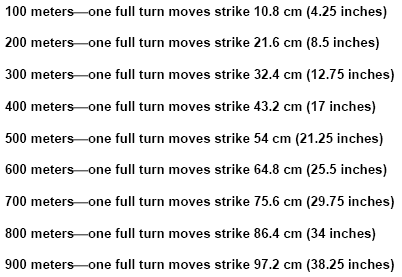
Elevation Correction Chart for the M240B
Windage Correction Chart for the M240B