A proper grip is one of the
most important fundamentals of quick fire. The weapon must become an
extension of the hand and arm; it should replace the finger in pointing at
an object. The firer must apply a firm, uniform grip to the weapon.
One-Hand Grip.
- Hold the weapon in the nonfiring hand.
- Form a V with the thumb and forefinger
of the strong hand (firing hand).
- Place the weapon in the V with the front
and rear sights in line with the firing arm.
- Wrap the lower three fingers around the
pistol grip, putting equal pressure with all three fingers to the rear.
- Allow the thumb of the firing hand to
rest alongside the weapon without pressure.
- Grip the weapon tightly until the hand
begins to tremble; relax until the trembling stops. At this point, the
necessary pressure for a proper grip has been applied.
- Place the trigger finger on the trigger
between the tip and second joint so that it can be squeezed to the rear.
The trigger finger must work independently of the remaining fingers.
NOTE: If any of the three fingers on the
grip are relaxed, the grip must be reapplied.
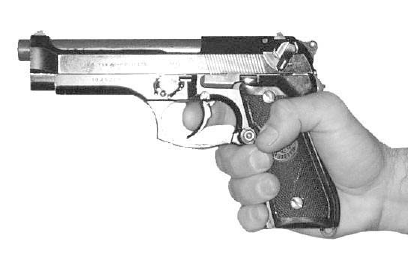
One-Hand Grip
Two-Hand Grip.
The two-hand grip allows the firer to steady the firing hand and provide
maximum support during firing. The nonfiring hand becomes a support
mechanism for the firing hand by wrapping the fingers of the nonfiring hand
around the firing hand. Two-hand grips are recommended for all pistol
firing.
WARNING: Do not place the nonfiring
thumb in the rear of the weapon. The recoil upon firing could result in
personal injury.
- Fist Grip.
- Grip the weapon as with the one-hand
grip.
- Firmly close the fingers of the
nonfiring hand over the fingers of the firing hand, ensuring that the
index finger from the nonfiring hand is between the middle finger of the
firing hand and the trigger guard.
- Place the nonfiring thumb alongside
the firing thumb
NOTE: Depending upon the individual
firer, he may chose to place the index finger of his nonfiring hand on the
front of the trigger guard since M9 and M11 pistols have a recurved trigger
guard designed for this purpose.
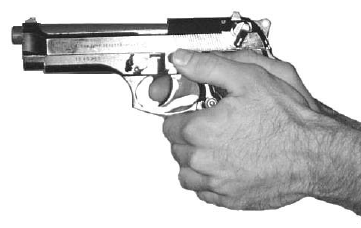
Fist Grip
- Palm-Supported Grip.
This grip is commonly called the cup and saucer grip.
- Grip the firing hand as with the
one-hand grip.
- Place the nonfiring hand under the
firing hand, wrapping the nonfiring fingers around the back of the
firing hand.
- Place the nonfiring thumb over the
middle finger of the firing hand.
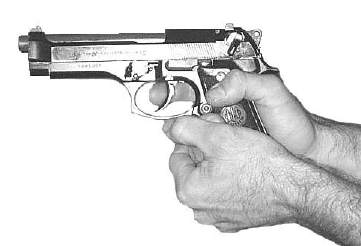
Palm-Supported Grip
- Weaver grip.
Apply this grip the same as the fist grip. The only exception is that the
nonfiring thumb is wrapped over the firing thumb.
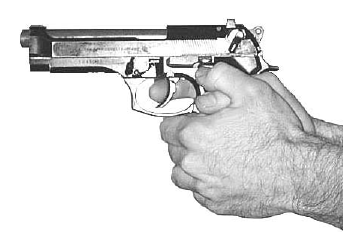
Weaver Grip
Isometric Tension.
The firer raises his arms to a firing position and applies isometric
tension. This is commonly known as the push-pull method for maintaining
weapon stability. Isometric tension is when the firer applies forward
pressure with the firing hand and pulls rearward with the nonfiring hand
with equal pressure. This creates an isometric force but never so much to
cause the firer to tremble. This steadies the weapon and reduces barrel rise
from recoil. The supporting arm is bent with the elbow pulled downward. The
firing arm is fully extended with the elbow and wrist locked. The firer must
experiment to find the right amount of isometric tension to apply.
NOTE: The firing hand should exert the
same pressure as the nonfiring hand. If it does not, a missed target could
result.
Natural Point of Aim.
The firer should check his grip for use of his natural point of aim. He
grips the weapon and sights properly on a distant target. While maintaining
his grip and stance, he closes his eyes for three to five seconds. He then
opens his eyes and checks for proper sight picture. If the point of aim is
disturbed, the firer adjusts his stance to compensate. If the sight
alignment is disturbed, the firer adjusts his grip to compensate by removing
the weapon from his hand and reapplying the grip. The firer repeats this
process until the sight alignment and sight placement remain almost the same
when he opens his eyes. With sufficient practice, this enables the firer to
determine and use his natural point of aim, which is the most relaxed
position for holding and firing the weapon.
|

