|
Conditions:
Given a standard 1:50,000 scale military
map, a pencil, and a designated point on the
map.
Standards:
Determined the elevation of the designated
point to within half the value of the
contour interval.
|
Performance Steps
|
|
1.
Locate contour lines and
contour intervals.
|
a.
The brown lines on the map are
called contour lines. Each line shows
the height above sea level. Contour
lines never cross one another. Printed
at the bottom of the map is the
contour interval, which is the
difference in height (elevation)
between one brown line and the one on
either side of it. On a map with a
scale of 1:50,000, the contour
interval is usually 20 meters. This
would make point A 80 meters higher or
lower than point B (figure C-23).
|
|
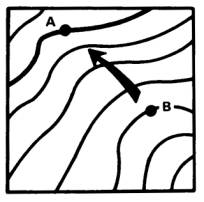
Figure C-23. Contour lines
|
b. You can easily tell from the brown lines the direction of uphill or
downhill because every fifth line is
heavier and has a number that gives
its elevation. Let’s say the contour
interval is 20 meters again. Now you
can tell that point B. Also, if you
know the distance between A and B, you
can get an idea of the steepness of
the slope (figure C-24).
|
|
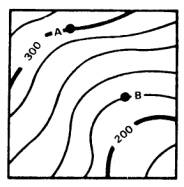
Figure C-24. Contour intervals
|
c.
Widely spaced contour lines
show a gentle slope. When they are
close together, the slope is steep
(figure C-25).
|
|
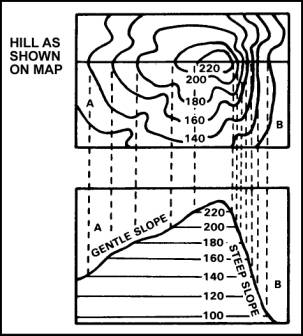
Figure C-25. Slope
|
d.
When the contour lines are
close together at the top of the hill,
the hilltop is pointed. When the
contour lines are widely spaced, the
hilltop is flat (figure C-26).
|
|
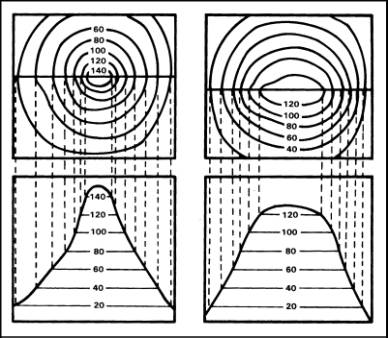
Figure C-26.
Elevation
|
|
2.
Determine elevation.
|
a.
Locate the point on the map.
(It may already be plotted on the map,
or given as eight-digit coordinates).
|
b.
Determine the contour interval
of the map from the marginal
information.
|
c.
Locate the index contour line
nearest the point for which the
elevation is being sought.
|
d.
Count the number of contour
lines, up or down, that must be
crossed to go from the numbered lines
to the point, and note the direction
to the point. If the point is on a
contour line, its elevation is that of
the contour line. For points between
contour lines-
|
(1)
Points less than one-fourth the
distance between lines are considered
to be the same as the elevation of the
nearest line.
|
(2)
Point one-fourth to
three-fourths the distance from the
lower line are considered to be at an
elevation half the contour interval
above the lower line.
|
e.
To estimate the elevation of
the top of an unmarked hill, add half
the contour interval to the elevation
of the highest contour line around the
hill.
|
f.
To estimate the elevation of
the bottom of depression, subtract
half the contour interval from the
elevation of the lowest contour around
the depression.
|
g.
On maps that do not show
elevation and relief as much detail as
needed, supplementary contour lines
may be used. Marginal information
indicates the interval, and the
supplementary lines are used exactly
like solid contour lines.
|
h.
Benchmarks and spot elevation
also indicate points of known
elevation.
|
Evaluation
Preparation:
Setup:
Provide the soldier with a 1:50,000 scale
military map, a designated point on the map
labeled "A", and a pencil.
Brief
Soldier: Tell the soldier to determine
the elevation of the point that is labeled
"A" on the map.
|
Performance Measures
|
GO
|
NO
GO
|
|
1.
Determined the correct
elevation within half the value of the
contour interval.
|
—
|
—
|
|
Note. If the contour interval of the map is in feet, the
answer must be in feet. If the contour
interval is in meters, the answer must
be in meters.
|
|
|
Evaluation
Guidance:
Score the soldier GO if the
performance measure is passed. Score the
soldier NO GO if the performance measure is
failed. If the soldier scores NO GO, show
what was done wrong and how to do it
correctly.
|
References
|
|
|
Required
|
Related
|
|
|
FM
3-25.26
|
|
|

