Handling A Compass
COMPASS HANDLING
Compasses are delicate instruments and should be cared for accordingly.
a. Inspection. A detailed inspection is required when first obtaining and using a compass. One of the most important parts to check is the floating dial, which contains the magnetic needle. The user must also make sure the sighting wire is straight, the glass and crystal parts are not broken, the numbers on the dial are readable, and most important, that the dial does not stick.
b. Effects of Metal and Electricity. Metal objects and electrical sources can affect the performance of a compass. However, nonmagnetic metals and alloys do not affect compass readings. The following separation distances are suggested to ensure proper functioning of a compass:
High-tension power lines …………………………………………. 55 meters.
Field gun, truck, or tank ………………………………………….. 18 meters.
Telegraph or telephone wires and barbed wire ……………. 10 meters.
Machine gun …………………………………………………………. 2 meters.
Steel helmet or rifle …………………………………………………. 1/2 meter.
c. Accuracy. A compass in good working condition is very accurate. However, a compass has to be checked periodically on a known line of direction, such as a surveyed azimuth using a declination station. Compasses with more than 3° + variation should not be used.
d. Protection. If traveling with the compass unfolded, make sure the rear sight is fully folded down onto the bezel ring. This will lock the floating dial and prevent vibration, as well as protect the crystal and rear sight from damage.USING A COMPASS
Magnetic azimuths are determined with the use of magnetic instruments, such as lensatic and M2 compasses. The techniques employed when using the lensatic compass are as follows:
a. Using the Centerhold Technique. First, open the compass to its fullest so that the cover forms a straightedge with the base. Move the lens (rear sight) to the rearmost position, allowing the dial to float freely. Next, place your thumb through the thumb loop, form a steady base with your third and fourth fingers, and extend your index finger along the side of the compass. Place the thumb of the other hand between the lens (rear sight) and the bezel ring; extend the index finger along the remaining side of the compass, and the remaining fingers around the fingers of the other hand. Pull your elbows firmly into your sides; this will place the compass between your chin and your belt. To measure an azimuth, simply turn your entire body toward the object, pointing the compass cover directly at the object. Once you are pointing at the object, look down and read the azimuth from beneath the fixed black index line. This preferred method offers the following advantages over the sighting technique:
(1) It is faster and easier to use.
(2) It can be used under all conditions of visibility.
(3) It can be used when navigating over any type of terrain.
(4) It can be used without putting down the rifle; however, the rifle must be slung well back over either shoulder.
(5) It can be used without removing eyeglasses.
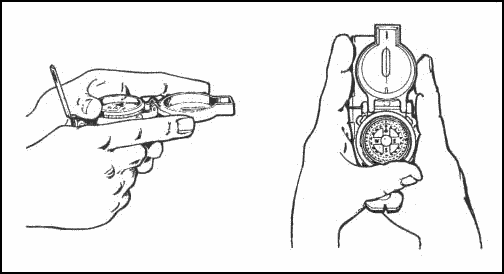
Figure 9-2. Centerhold technique.
b. Using the Compass-to-Cheek Technique. Fold the cover of the compass containing the sighting wire to a vertical position; then fold the rear sight slightly forward. Look through the rear-sight slot and align the front-sight hairline with the desired object in the distance. Then glance down at the dial through the eye lens to read the azimuth.
NOTE: The compass-to-cheek technique is used almost exclusively for sighting, and it is the best technique for this purpose.
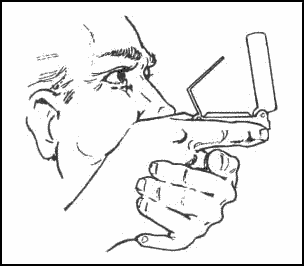
Figure 9-3. Compass-to-cheek technique.

