Determine the grid coordinates of a point on a military map
CONDITIONS
Given a standard 1:50,000 scale military map, a 1:50,000 grid coordinate scale, pencil, paper, and a point on the map for which coordinates must be determined.
STANDARDS
Determine the six-digit grid coordinates for the point on the map with a 100?meter tolerance (grid coordinates must contain the correct two-letter 100,000 meter-square identifier).
TRAINING AND EVALUATION
Training Information Outline
Notes: 1. To keep from getting lost, a soldier must know how to find out where he is. A combat area has no street addresses, but a military map can help you identify a location accurately. The map has vertical lines (top to bottom) and horizontal lines (left to right). These lines form small squares 1,000 meters on each side called grid squares.
2. The lines that form grid squares are numbered along the outside edge of the map picture. No two grid squares have the same number.
3. The precision of a point location is shown by the number of digits in the coordinates: the more digits, the more precise the location.
1996- a 1,000-meter grid square.
192961- to the nearest 100 meters.
19269614- to the nearest 10 meters.
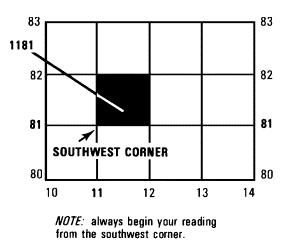
1. Look at Figure 5-18. Your address is grid square 1181. How do you know this? Start from the left and read right until you come to 11, the first half of your address. Then read up to 81, the other half. Your address is somewhere in grid square 1181 (A, Figure 5-18).
2. Grid square 1181 gives your general neighborhood, but there is a lot of ground inside that grid square. To make your address more accurate, just add another number to the first half and another number to the second half-so your address has six numbers instead of four.
a. To get those extra numbers, pretend that each grid square has ten lines inside it running north and south, and another 10 running east and west. This makes 100 smaller squares. You can estimate where these imaginary lines are.
b. Suppose you are halfway between grid line 11 and grid line 12. Then the next number is 5 and the first half of your address is 115. Now suppose you are also 3/10 of the way between grid line 81 and grid line 82. Then the second half of your address is 813. (If you were exactly on line 81, the second part would be 810). Your address is 115813 (B, Figure 5-18).
Figure 5-18. Determining a six-digit grid coordinate.
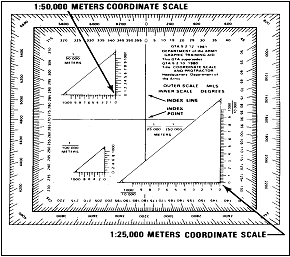
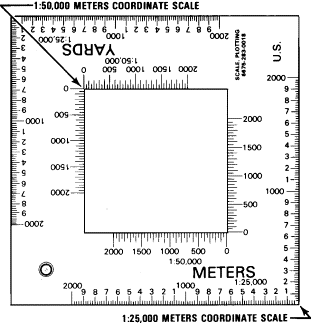
3. The most accurate way to determine the coordinates of a point on a map is to use a coordinate scale. You do not have to use imaginary lines; you can find the exact coordinates using a Coordinate Scale and Protractor (GTA 5-2-12) (Figure 5-19) or a Plotting Scale (Figure 5-20). Each device has two coordinating scales, 1:25,000 meters and 1:50,000 meters. Make sure you use the correct scale.
Figure 5-19. Coordinate scale and protractor.
a. First, locate the grid square in which the point (for example, Point A, Figure 5-21, page 5-24) is located (the point should already be plotted on the map).
b. The number of the vertical grid line on the left (west) side of the grid square is the first and second digits of the coordinates.
Figure 5-20. Plotting scale.
c. The number of the horizontal grid line on the bottom (south) side of the grid square is the fourth and fifth digits of the coordinates.
d. To determine the third and sixth digits of the coordinates, place the coordinate scale on the bottom horizontal grid line of the grid square containing Point A.
Figure 5-21. Placement of coordinate scale.
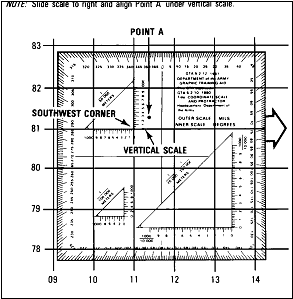
e. Check to see that the zeros of the coordinate scale are in the lower left-hand (southwest) corner of the map grid square (Figure 5-21).
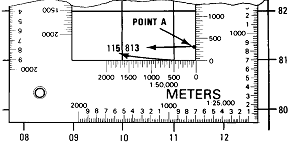
f. Slide the scale to the right, keeping the bottom of the scale on the bottom grid line until Point A is under the vertical (right-hand) scale (Figures 5-22 and 5-23). On the bottom scale, the 100-meter mark nearest the vertical grid line provides the third digit, 5. On the vertical scale, the 100-meter mark nearest Point A provides the sixth digit, 3. Therefore, the six-digit grid coordinate is 115813.
Figure 5-22. Alignment of coordinate scale.
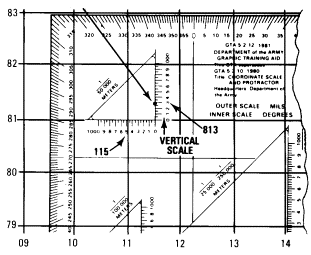
Figure 5-23. Alignment of plotting scale.
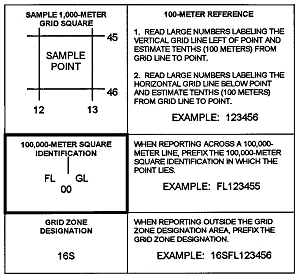
g. To determine the correct two-letter 100,000?meter square identifier, look at the grid reference box in the margin of the map (Figure 5-24).
h. Place the 100,000-meter square identifier in front of the coordinate, GL 11508133.
Figure 5-24. Grid reference box.
Evaluation Guide:
Determine the Grid Coordinates of a Point on a Military Map
Performance Measures
1. Write down the two-letter 100,000-meter square identifier and the six?digit grid coordinates for the designated point with a 100?meter tolerance.
2. Record the grid coordinates with the correct two-letter 100,000-meter square identifier.

